
Every year, around the time Delhi’s summer hits 45°C, we get the same kind of phone call. Someone installed louvers a couple of seasons ago, and now the blades are sagging, the paint is chalking, or the whole thing rattles in the evening wind. The problem is rarely the louver design. It’s usually the aluminium louvers suppliers they picked, and what they didn’t ask before ordering.
I’ve spent over two decades around aluminium sections, and the pattern is always the same. People compare price per metre, skip the questions that matter, and pay for it later. This guide will help you avoid that.
Why Aluminium Louvers Make Sense for Delhi Weather
Delhi is tough on building materials. Heat, dust, monsoon humidity, and pollution all attack exteriors together. Timber warps and steel rusts. Aluminium louvers handle this far better because the metal forms a natural oxide layer and doesn’t corrode the way iron does.
They’re also light, which makes installation on upper floors and facades easier, and they let you control airflow and sunlight without turning a room into a sealed box. That’s why you’ll see them on:
- Building facades and ventilation louvers for commercial spaces
- Sunshades over windows and balconies
- Gate infills and boundary screens that need privacy with airflow
- Plant rooms, AC enclosures, and utility areas
- Partitions and decorative screens inside showrooms and offices
Fixed vs Adjustable Louvers: Decide This First
Before you even speak to a supplier, know which type you need, because it changes everything from the profile to the price.
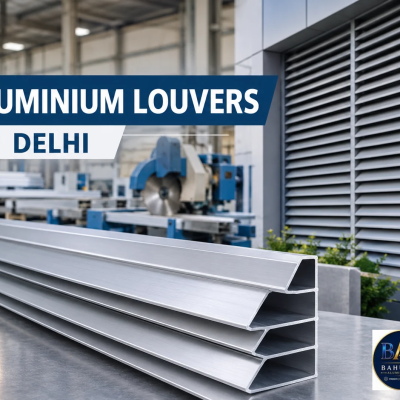
Fixed louvers hold the blades at a set angle. They’re simple, sturdy, and nearly maintenance-free. Good for facades, ventilation openings, and screens where you don’t need to change anything after installation.
Adjustable louvers let you tilt the blades to control light, heat, and privacy. They suit offices, terraces, and homes where the sun angle changes through the day. More moving parts means a bit more attention over the years, so the quality of the pivot and fittings matters a lot here.
A good supplier will ask where the louvers are going before quoting. If someone gives you a rate without asking about the application, treat that as a warning sign.
7 Things to Check Before You Pick Aluminium Louvers Suppliers
1. Alloy and wall thickness
Most architectural sections are made from 6063 grade aluminium, which extrudes well and takes finishes nicely. But the grade alone isn’t the whole story. Wall thickness decides how well a blade resists bending, especially on longer spans. Ask for the actual thickness in millimetres, and don’t settle for “heavy duty” as an answer.
2. Finish: powder coating or anodizing
Both work well, but they behave differently. Powder-coated aluminium gives you a wide colour range, including wood-look finishes, and is the usual choice for gates and facades. Anodized finishes have a metallic look and tend to age gracefully. Ask what coating thickness they apply and whether it’s done in-house or outsourced. In Delhi’s dusty, sunny conditions, a thin coating is the first thing to fade.
3. Blade profile and design range
Flat blades, aerofoil shapes, and slimmer decorative profiles all do different jobs. A supplier with a wide range lets you match the profile to your project rather than forcing your project to fit whatever they have in stock. Look for aluminium louver profiles in several sizes and shapes, plus the option of custom colours.
4. Whether they actually manufacture or just resell
Honestly, this matters more than most buyers realise. Suppliers who work directly with extrusion and finishing can fix a defect, match a colour batch, or cut a custom length. Resellers often can’t. Ask where the sections come from and whether you can see the stock.
5. Consistency across batches
A shade mismatch between two deliveries is one of the most irritating problems on a site. Ask how they handle repeat orders, especially if your project will be supplied in phases.
6. Delivery and stock availability
Construction schedules don’t wait. A supplier in or close to Delhi NCR with ready inventory can save you weeks compared to ordering from another state and waiting on freight.
7. After-sales guidance
Can they advise on fittings, fixing methods, and spacing between blades? Good aluminium louvers suppliers don’t disappear after billing. They answer the “how do I fix this on a brick wall?” call too.
What About Aluminium Louvers Price in Delhi?
I’ll be straight with you: nobody can give a fair number without knowing your profile, thickness, finish, quantity, and size. Rates vary with the aluminium market, which moves regularly, so a quote from last quarter may not hold today.
What I’d suggest is comparing quotes on a like-for-like basis. Same alloy, same thickness, same coating spec. The cheapest quote usually has a thinner wall or lighter coating hiding in it, and that’s where the long-term cost shows up.
Mistakes I See Buyers Make Again and Again
- Buying on price alone. A louver that needs replacing in four years isn’t cheap.
- Ignoring span and wind load. Long blades on high-rise facades need stronger profiles or extra support.
- Skipping a sample. Always look at a physical piece in daylight before approving a colour.
- Forgetting the fittings. Even great profiles fail with poor brackets and fasteners.
- Not asking for the catalogue. If a supplier can’t show you their range clearly, be careful.
Why Delhi Buyers Trust Bahubali Aluminium
At Bahubali Aluminium Co., we’ve been working with aluminium profiles from our base in Paharganj, New Delhi, for over 25 years. Architects, builders, fabricators, and contractors come to us for facade sections, railings, gate profiles, and louvers. We offer fixed and adjustable styles, in powder-coated, anodized, and custom finishes, for homes, offices, and industrial sites across Delhi NCR.
You can explore our full Gate & Louvers Profiles range, flip through the catalogue, or simply call us with your project details. Sometimes a five-minute conversation saves a lot of rework. If you’re also planning doors or windows, our guide to aluminium door profiles suppliers may help too.
Quick Checklist Before You Order
- Confirm whether you need fixed or adjustable louvers.
- Ask for alloy grade and wall thickness in writing.
- Check the finish type and coating thickness.
- See a physical sample in natural light.
- Confirm stock, lead time, and delivery to your site.
- Ask about fittings and fixing support.
- Compare quotes on the same specification.
Frequently Asked Questions
Are aluminium louvers good for outdoor use in Delhi?
Yes. They resist rust, handle heat and monsoon moisture well, and need very little upkeep, especially with a good powder-coated or anodized finish.
How long do aluminium louvers last?
With quality material and a proper finish, they commonly last well over a decade. Cleaning them occasionally with mild soap and water is usually enough.
Can I get louvers in custom colours?
Yes, powder coating allows a wide range of colours and textures, including wood-grain finishes. Share your requirement with the supplier early so they can match it.
What’s the difference between aluminium louvers suppliers and manufacturers?
A manufacturer controls extrusion and finishing, while a supplier may only resell. Ask directly, since it affects quality control and customisation.
Do I need adjustable louvers for a facade?
Not always. Fixed louvers are simpler and cheaper to maintain, so they’re often the better choice for facades. Adjustable ones make more sense where you want to control light inside a room.
Final Thoughts
Choosing among aluminium louvers suppliers isn’t really about finding the lowest rate. It’s about finding someone who understands your project, shows you what they’re selling, and stands behind it when the first monsoon arrives. Ask the questions above and you’ll filter out most of the wrong choices quickly.