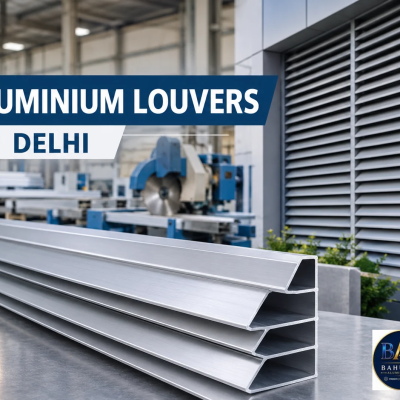

Most people shop for louvers the way they shop for tiles. They look at the finished piece, compare the rate, and decide. With louvers, that order is backwards.
What you see on a showroom table is the last step of a long process. The things that decide whether your louver survives ten Delhi summers (the die, the alloy, the cooling, the finishing) all happen before it ever reaches you. If you’re searching for an aluminium louver manufacturer Delhi, understanding that process is the quickest way to ask better questions and spot a weak quote.
So let’s walk through it, plainly.
Manufacturer, Supplier, Fabricator: Who Does What?
These words get mixed up constantly, so here’s the simple version.
- A manufacturer works on the section itself: its shape, its alloy, its finish.
- A supplier sells sections that are already made, usually from stock.
- A fabricator takes those sections and builds the final louver panel, gate or screen on site or in a workshop.
Many businesses do a bit of two or three of these. That’s normal. What matters is that you know which part of the chain you’re actually paying for. (If you want a checklist for comparing sellers, we’ve covered that in our guide on how to choose blades, finish and fit.)
How an Aluminium Louver Is Made, Step by Step
1. The profile and the die
Every louver blade starts as a shape on paper: flat, aerofoil, slimmer decorative, whatever the design needs. That shape is cut into a steel die. The die is what gives every blade its exact cross-section, so a worn or poorly made die means blades that vary slightly from one length to the next. You’ll notice that only when you try to line them up on a wall.
2. Extrusion
A solid aluminium billet is heated until it’s soft enough to move, then pushed through the die under pressure. What comes out is a long, continuous section in the shape of your blade. Architectural sections are usually made from 6063 alloy, which extrudes cleanly and takes finishes well.
3. Cooling, straightening and ageing
Fresh from the press, the section is cooled, stretched slightly to straighten it, and cut to length. It then goes through an ageing process that brings it to its final strength, which is what the “T5” or “T6” on a spec sheet refers to. Skipping or rushing this stage is how you end up with blades that bend more easily than they should.
4. Surface preparation and finishing
This is the step buyers underestimate. Before any colour goes on, the surface has to be cleaned and pre-treated so the coating can grip. Then comes the finish:
- Powder coating: dry powder is sprayed on and baked in an oven so it fuses into a tough, even layer. This is why powder coated aluminium louvers come in such a wide range of colours and textures, including wood-look finishes.
- Anodising: an electrochemical process that builds a hard, metallic surface from the aluminium itself.
Poor preparation shows up later as peeling or chalking, usually after the first monsoon or two. If you’d like a deeper look at how finishes hold up here, our guide to powder coated aluminium profiles for Delhi’s heat, dust and monsoon goes into it.
4b. Cutting, drilling and assembly
Finished sections are cut to the lengths your project needs, drilled or notched for fixing, and, where required, assembled into a louver panel with frames, end caps and pivots (for adjustable types).
5. Inspection and packing
Last, the pieces are checked for straightness, finish and size before they’re packed. This is also the moment where a careful manufacturer separates batches, so the material for one wall doesn’t end up in mismatched shades.
One honest tip: not every business in this market does every step under its own roof. Some outsource coating or cutting. That isn’t automatically bad, but it’s worth asking, because it affects lead time and how quickly a problem can be fixed.
What You Can Actually Customise
A good aluminium louver manufacturer in Delhi should be able to work around your drawing rather than make you fit their stock. At Bahubali Aluminium Co., our louver profiles can be customised in:
- Size and length to suit your openings
- Design, in both fixed and adjustable aluminium louvers
- Finish, whether powder-coated, anodised or a custom colour
That range covers the usual uses: gates, fences, ventilated facades, sunshades and partitions. If you’re planning something larger, such as a full elevation, it also helps to see how louvers sit alongside facade solutions or curtain wall systems so the finishes and lines match.
Five Process Questions Worth Asking Any Manufacturer
You don’t need an engineering degree. These five are enough to tell a prepared manufacturer from one who’s improvising:
- Where does each step happen? Extrusion, coating, cutting. Which are in-house and which are outsourced?
- Can I see a cut sample? Looking at the end of the blade tells you more about wall thickness than any brochure.
- How do you keep the colour consistent across batches? Especially important if your project is delivered in phases.
- What do you check before dispatch? Ask for specifics, not “quality is guaranteed”.
- What do you need from me to quote accurately? A manufacturer who asks about your application is usually a good sign.
Planning Tips for Delhi NCR Projects
Local conditions change how you should plan, so a few practical points:
- Measure after the civil work is done. Plastering and cladding can shift your opening size by a few millimetres, and louvers don’t forgive that.
- Order with a buffer. Allow for cutting waste and a spare piece or two, since matching a colour later is harder than ordering extra now.
- Plan for cleaning. Delhi’s dust settles quickly on horizontal blades. Think about how someone will reach them.
- Approve the sample in daylight. Colours look different under showroom lights and a 40°C afternoon sun.
Why Bahubali Aluminium Co.
Bahubali Aluminium Co. has been working with aluminium profiles for over 25 years from our base in Paharganj, New Delhi. Architects, builders, fabricators and contractors come to us for gate and louver profiles, facade sections, railings and more, across Delhi NCR. We’d always rather you see the actual section and finish in person than judge it from a photo.
You can browse our Gate & Louvers Profiles, flip through the catalogue, or if you’re also deciding on gates, read our aluminium gate profiles guide.
Frequently Asked Questions
Can I get aluminium louvers made in a custom size?
Yes. Custom lengths, designs and finishes are possible. Share your opening sizes and application, and confirm lead time before you finalise.
What information should I send for a quote?
Opening width and height, number of openings, fixed or adjustable, indoor or outdoor, preferred finish, and a photo or rough drawing.
Is powder coating or anodising better for louvers?
Neither wins every time. Powder coating offers more colours and textures; anodising gives a metallic look. Choose based on appearance and exposure.
Can I visit before ordering?
Yes. Our office is at G-12 Pushpa Complex, D.B. Gupta Road, Paharganj, New Delhi. Call ahead so we can have the samples ready.
Final Thoughts
A louver is only as good as the steps behind it: the die, the alloy, the finish and the checks before dispatch. When you’re comparing an aluminium louver manufacturer in Delhi, ask how the product is made, not just what it costs. If you’re ready to discuss your project, get in touch with Bahubali Aluminium Co. with your sizes and requirements.