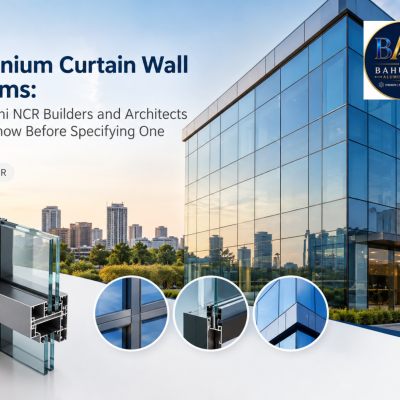

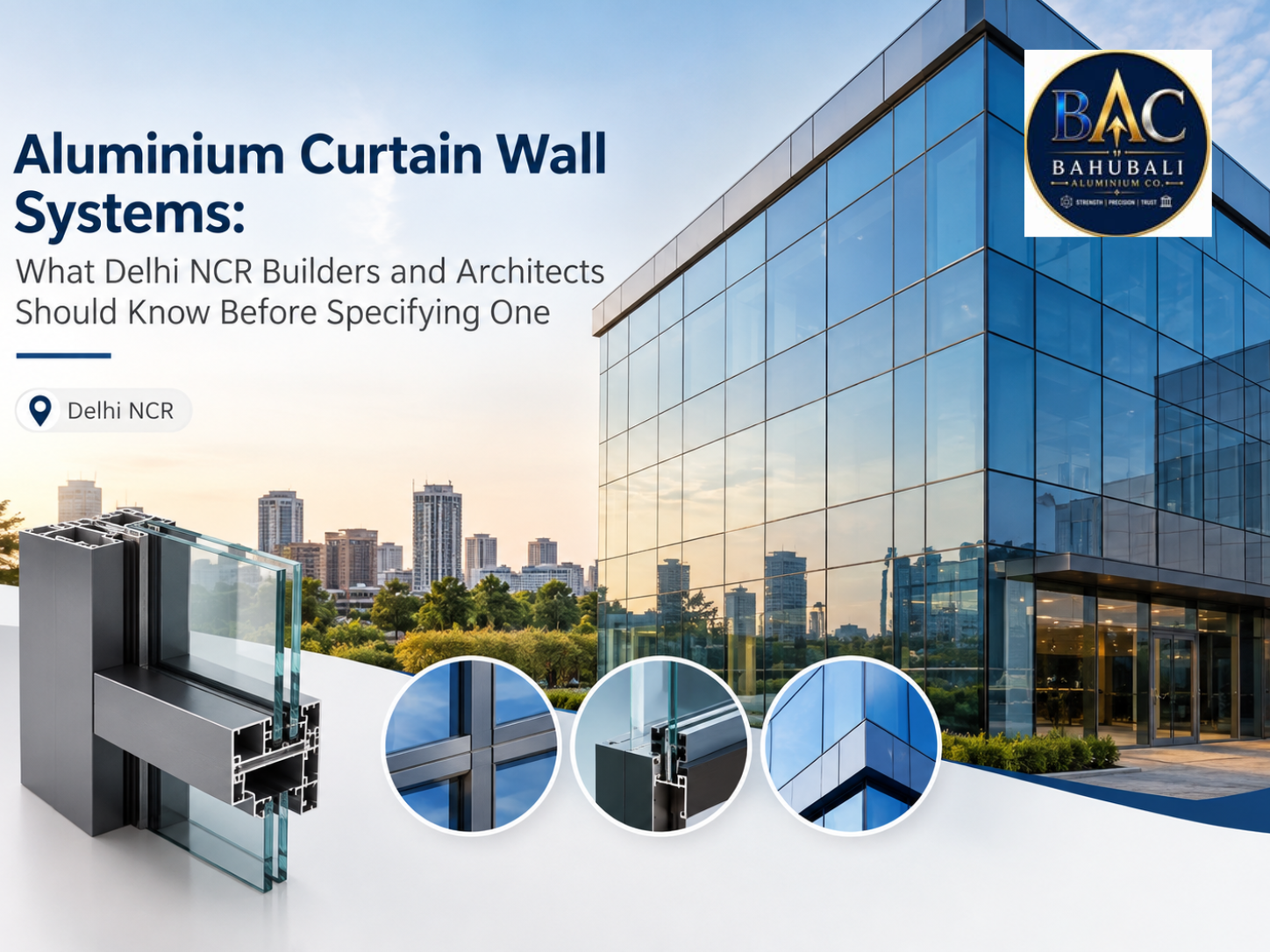
Walk down Golf Course Road in Gurugram or through the newer commercial blocks in Noida, and you will notice the same thing: glass, glass and more glass. What you don’t see is the quiet hero holding all of it in place. That hero is the frame, and in most modern buildings it comes from aluminium curtain wall systems.
If you are an architect drawing a new office frontage, a builder planning a showroom, or a fabricator quoting a project, this guide is for you. We have kept it practical. No brochure language, just what actually matters when these systems go from a drawing to a real wall in Delhi’s heat, dust and monsoon.
What Are Aluminium Curtain Wall Systems?
A curtain wall is a non-structural outer skin of a building. It does not carry the weight of floors or roof. It only carries its own weight (glass, frame, fittings) and passes wind and other loads to the main structure through anchors.
Aluminium curtain wall systems are made from extruded aluminium sections, usually called mullions (vertical) and transoms (horizontal), that form a grid. Glass or panels are then fixed into that grid. Think of it as a very precise, very strong window frame that spans several floors.
People sometimes use “curtain wall”, “glass facade” and “facade profiles” as if they mean the same thing. They overlap, but they are not identical. The curtain wall is the system, the glass facade is how it looks, and the profiles are the raw sections the system is built from.
Why Aluminium Became the Default Choice
Steel framing is strong, but it is heavy and needs constant protection from rust. Timber is out of the question for most high-rise work. Aluminium wins for a few simple reasons:
- Light weight. Less dead load on the building, and easier handling on site.
- Corrosion resistance. Aluminium forms its own protective oxide layer, which matters during monsoon and in polluted city air.
- Extrusion flexibility. Complex shapes, built-in channels for gaskets and drainage, all in one section.
- Finish options. Powder coating and anodizing let you match almost any design brief.
- Recyclability. A real plus for projects chasing green building ratings.
The Main Parts of a Curtain Wall
Before you compare quotes, it helps to know what you are actually buying:
- Mullions and transoms: the vertical and horizontal frame members. Their depth and wall thickness decide how much glass load and wind pressure the wall can handle.
- Pressure plates and cover caps: hold the glass firmly against the frame and give the facade its clean external lines.
- Gaskets and sealants: the weatherproofing layer. Cheap gaskets are one of the first things to fail.
- Anchors and brackets: fix the frame to the slab edge and absorb movement.
- Glass units: single, double-glazed or laminated, chosen for heat, noise and safety.
The frame portion is made from curtain wall profiles, and the quality of those profiles shapes everything that follows.
Types of Aluminium Curtain Wall Systems
Stick-Built Systems
The frame is assembled piece by piece on site. It is the most common type in India because it is flexible, works well for small and mid-size projects, and transport is simple. The trade-off is that quality depends heavily on site workmanship.
Unitized Systems
Large panels are factory-assembled, glazed and then lifted into place. Installation is faster and quality control is better, which makes unitized systems popular for tall towers. They cost more and need careful planning early on.
Semi-Unitized and Structural Glazing
Semi-unitized systems mix both approaches. Structural glazing goes a step further: the glass is bonded to the frame with high-strength silicone, so no cover caps show on the outside. The result is that smooth, seamless glass look you see on premium buildings.
Designing for Delhi’s Climate
A system that works in Pune may struggle in Delhi. Here is what we always ask clients to think about:
- Summer heat. Delhi touches 45°C or more. Aluminium expands, so the system needs proper movement joints and a thermal break to cut heat transfer.
- Dust and pollution. Fine dust settles in gasket channels and on finishes. Smooth, well-coated surfaces are easier to clean and last longer.
- Monsoon. Water will find a way in. A good system has an internal drainage path so any water that enters can leave again.
- Wind and seismic load. Delhi NCR falls in a high seismic zone. Wind loads should be calculated per IS 875 (Part 3) and the National Building Code, and a structural consultant should confirm the section sizes.
The same logic applies across Delhi NCR, whether the site is in Gurugram, Noida, Faridabad or Ghaziabad.
Powder Coating or Anodizing?
Both are good. They suit different jobs.
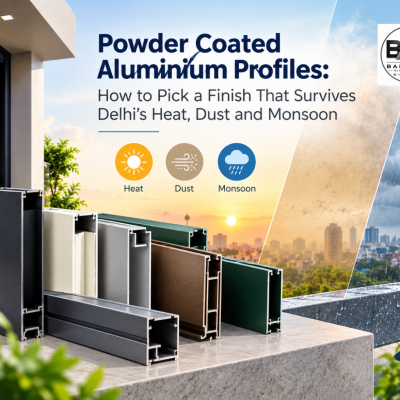
Powder-coated aluminium gives you a wide colour range and a tough, uniform finish. It is the usual pick when colour matching matters. Anodized aluminium has a more metallic look and is very durable, but the colour choices are narrower. Whichever you choose, ask for the coating thickness and the standard it follows (for example, IS 13871 for powder coatings and IS 1868 for anodic coatings). A supplier who hesitates on this question is a warning sign.
Where Projects Go Wrong
Over 25 years of supplying aluminium sections to Delhi’s fabricators and contractors, Bahubali Aluminium Co. has seen the same mistakes repeat:
- Profile too light for the glass. A thin section looks fine on paper but deflects under double-glazed units. Always check the glass weight against the section’s moment of inertia.
- No drainage planning. Leaks at transoms are almost always a drainage problem, not a sealant problem.
- Mixing batches. Sections from different extruders or batches can show slight colour and tolerance differences. On a long facade, you will see it.
- Ignoring tolerances at the slab edge. Concrete is never perfectly straight. The anchoring design must allow for adjustment.
- Choosing on price alone. The cheapest quote usually hides thinner walls or weaker alloy.
How to Choose the Right Supplier
When you shortlist a supplier for aluminium facade systems, run through this checklist:
- Is the alloy and temper clearly stated (6063-T5 or T6 is common for architectural work)?
- Can they show test reports or technical data for the sections?
- Do they offer both powder-coated and anodized finishes?
- Can they supply custom profiles or only standard ones?
- Is stock available locally, so your project does not stall waiting on delivery?
- Will they talk to your fabricator and consultant directly?
If you want to see what is available, you can browse our range of curtain wall sections and facade profiles, or download the product catalogue.
What Affects the Cost?
There is no single price for a curtain wall, because several things move it:
- Section depth and wall thickness
- Type of system (stick-built is usually cheaper than unitized)
- Glass specification
- Finish and colour
- Height of the building and access method
- Fabrication and installation complexity
The honest advice: fix your performance needs first, then compare quotes on equal terms.
Frequently Asked Questions
Are aluminium curtain wall systems suitable for Delhi’s weather?
Yes, provided the system includes thermal breaks, proper drainage and a durable finish. These details matter more than the brand name.
How long does an aluminium curtain wall last?
With good profiles, quality gaskets and basic maintenance, the frame can serve for several decades. Gaskets and sealants usually need replacement sooner than the aluminium itself.
Can curtain walls be used in residential buildings?
Absolutely. Many villas and premium apartments now use them for stairwells, living rooms and double-height spaces.
What is the difference between a curtain wall and a window wall?
A curtain wall runs past the floor slabs and hangs off the building edge. A window wall sits between slabs, floor to floor.
Can I get custom curtain wall profiles?
Yes. For larger projects, custom sections can be extruded to suit your design, subject to quantity and die cost.
Final Thoughts
A good curtain wall looks effortless, but a lot of planning sits behind that effortless look. Pick the right system type, size the sections properly, think about Delhi’s climate from day one, and buy from a supplier who understands the material.
If you are planning a project in Delhi NCR and need help with profiles, finishes or technical questions, the team at Bahubali Aluminium Co. is happy to talk it through. Call Sanjay Jain on +91 9811073759 or Samyak Jain on +91 9310488239, or visit us at G-12 Pushpa Complex, D.B. Gupta Road, Paharganj, New Delhi-110055. You can also contact us here.