
A few seasons ago, a fabricator walked into our shop with a glass partition that had started rattling. The glass was fine. The frame was fine. The culprit was a thin aluminium U profile that someone had picked only because it was the cheapest one on the shelf. The walls of the section had flexed, the glass had loosened, and the whole job had to be redone.
It’s a small, humble section. But after more than 25 years of handling aluminium in Delhi, we can tell you this: the U shape quietly holds up more of your project than most people realise. Let’s go through what it is, where it’s used, and how to choose the right one without learning the hard way.
What Is an Aluminium U Profile?
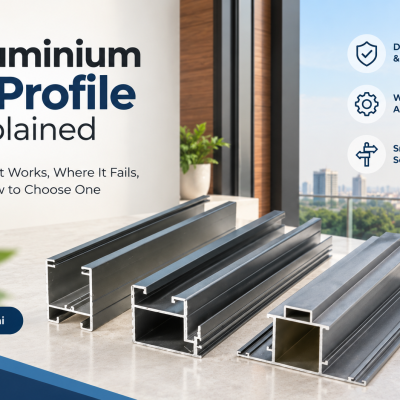
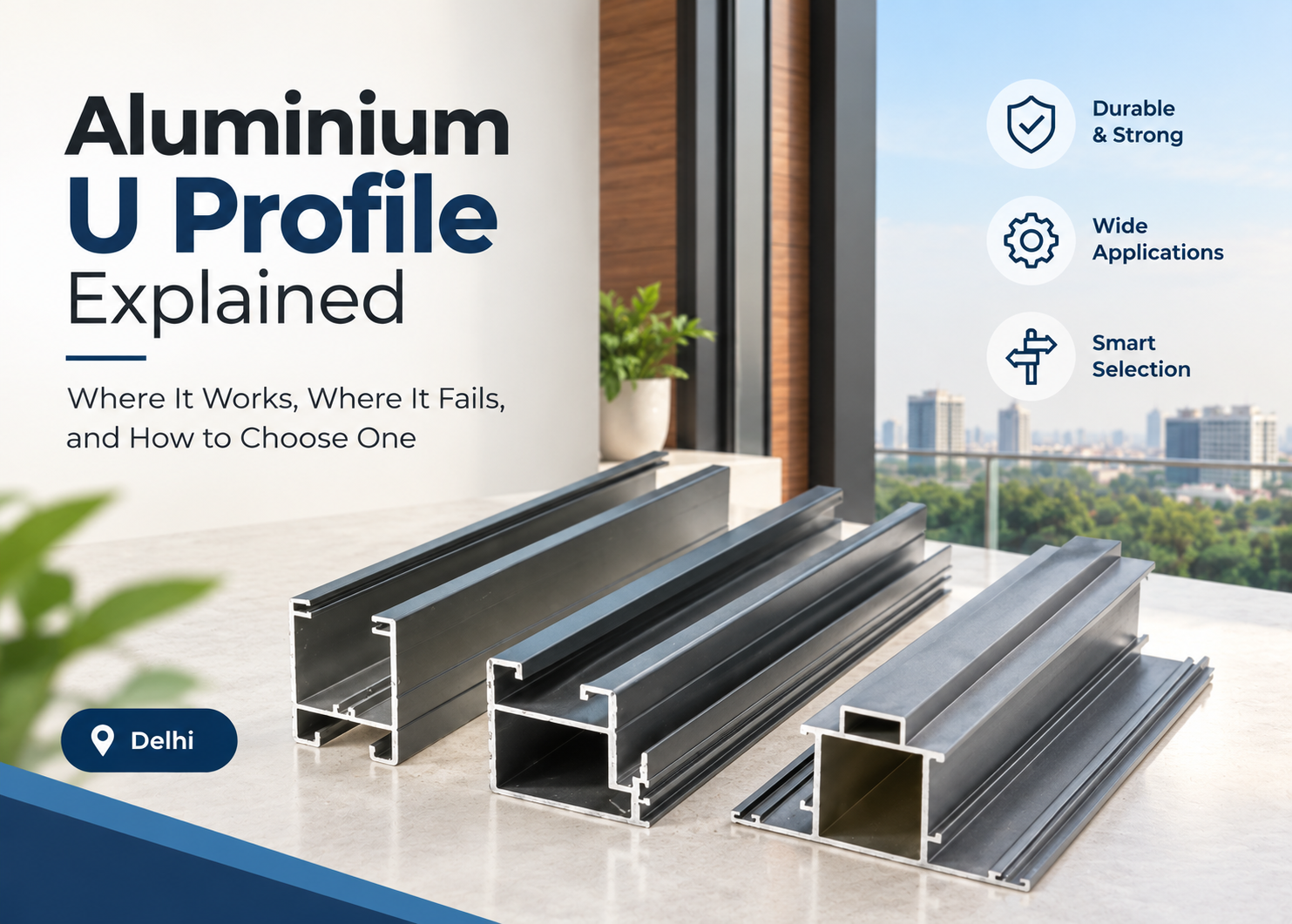
An aluminium U profile is an extruded section whose cross-section looks like the letter U: a flat base with two vertical legs on either side. You’ll also hear it called an aluminium U channel or aluminium U section on job sites, and a U shape aluminium profile in catalogues. Different words, same basic idea.
The shape matters because it creates a pocket. That pocket can grip a glass edge, hide an LED strip, cap the raw edge of a panel, or guide a sliding part. It’s an aluminium extrusion profile, which means the metal is pushed through a die, so the shape stays consistent along the whole length. That’s also why it can be made in so many sizes.
Most architectural U profiles are made from 6063 alloy, usually in T5 or T6 temper. It’s the alloy most people prefer for visible work because it takes anodising and powder coating well and is easy to cut, drill and fit.
Where We See U Profiles Used Most
This is where the section earns its place. In our experience, these are the jobs that ask for it most often:
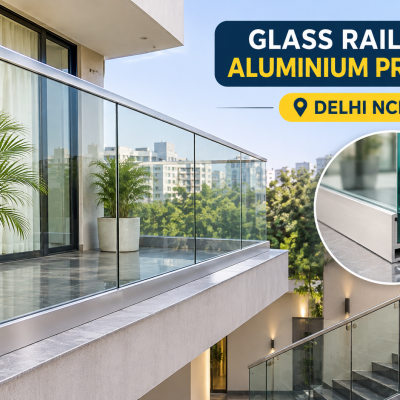
- Glass fitting and railings. A glass fitting U channel forms the base shoe for frameless balcony and staircase glass. If you’re comparing options for this, our guide on the aluminium railing profile covers what makes a railing last.
- Partitions and office glazing. Top and bottom U tracks hold the glass neatly and keep the line clean.
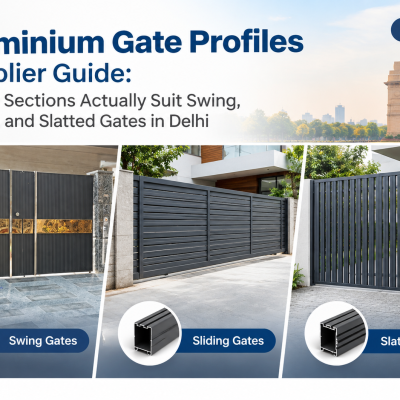
- Gate and louver frames. U sections stiffen the edges and give blades a proper seat. See our gate and louver profiles.
- LED and lighting channels. The open face lets light through while the legs protect the strip. More on this in our LED skirting profiles.
- Edge trims and ceiling work. A U profile finishes the raw edge of boards, panels and false ceilings.
- Industrial frames and guides. Lightweight rails for machines, sliding trays and covers.
U Profile vs Channel vs Angle: Quick Clarity
People mix these up all the time, and it leads to wrong orders. A U profile has two legs and a base, so it grips something from both sides. An aluminium angle has only one leg off the base, so it supports from one side. A plain channel can be a broader category and, depending on the supplier, may include C or T shapes too.
If you’re mainly trying to understand channels as a family of products, we wrote a separate buying guide on aluminium channels. This article stays focused on the U shape itself and how to specify it properly.
How to Choose the Right Aluminium U Profile
Here’s the checklist we walk customers through at the counter.
1. Match the internal width to the thing it holds. For glass, the gap must suit the glass thickness plus the gasket or packing. Too tight and you can’t seat it. Too loose and it rattles. Measure the actual glass, not what the drawing says.
2. Don’t ignore wall thickness. This is the mistake behind the rattling partition. A thin wall looks the same as a thicker one in a photo, but under load it flexes. Light trim work can use thinner walls. Anything carrying glass, a railing or repeated movement should be thicker.
3. Check the temper and alloy. Ask for 6063 T5 or T6 and get it in writing. A harder temper gives better stiffness, but a very hard section can crack if you bend it, so decide whether it will be cut straight or formed.
4. Look at the straightness. Roll a length on a flat surface or sight down it. Twisted or bowed sections cause gaps that no sealant can hide.
5. Pick the finish for your location, not just your taste. More on that below.
6. Ask about length and cutting. Standard lengths suit most jobs, but if you’re cutting many small pieces, planning the lengths saves a lot of waste.
Finish: What Survives Delhi’s Weather
Delhi is hard on metal. Summers push past 40°C, dust gets into everything, and monsoon humidity does the rest. Bare aluminium will oxidise and go dull, so finish isn’t optional for visible work.
There are two main routes. Anodising builds a hard oxide layer into the surface and suits a natural, metallic look. Powder coated aluminium profiles give you colour choice, from matte black to wood-tone shades, and a thicker protective film. For exteriors and balconies, a good powder coat is usually the more forgiving option. If you want the detail, our guide to powder coated aluminium profiles explains how to pick one that lasts.
One practical tip: cut and drill before coating where you can. Cutting a finished section exposes bare metal at the edge, and that’s where trouble starts.
Quick Reference: What to Look for by Application
| Application | What matters most | Finish suggestion |
|---|---|---|
| Glass railing base | Thick walls, straight length | Powder coat or anodised |
| Office partition track | Accurate internal width | Anodised silver or black |
| LED channel | Clean inner face, neat finish | Anodised or white powder coat |
| Gate or louver frame | Strength, weather resistance | Powder coat |
| Edge trim | Neat edge, light weight | Anodised |
Mistakes We See Again and Again
- Buying on price per kilo without checking wall thickness
- Choosing a size from a drawing instead of measuring the actual material
- Mixing sections from different batches, which leads to slightly different shades and dimensions
- Using an interior-grade finish on an outdoor balcony
- Skipping a sample before placing a large order
None of these are hard to avoid. They just need five minutes of attention before the order goes in.
Mistakes We See Again and Again
At Bahubali Aluminium Co., we’ve been supplying aluminium sections from our Paharganj base for over 25 years. Fabricators, architects and contractors across Delhi NCR bring us their drawings, and we help them match the right U profile to the job, not just the nearest size. You can browse the full range on our products page or check the catalogue before you visit.
If you’re not sure which section fits, send us your measurements and application. It’s much cheaper to sort that out on a call than on site.
Frequently Asked Questions
What is an aluminium U profile used for?
It’s used for glass fitting, railings, partitions, LED housings, edge trims, gate frames and light industrial guides. Anywhere something needs to be held, capped or guided from two sides.
Is an aluminium U channel the same as a U profile?
In everyday use, yes. Both describe the same U-shaped section. Some suppliers use “channel” more broadly, so always confirm dimensions with a drawing.
Which finish is best for outdoor use in Delhi?
Powder coating is usually the safer choice for exteriors because of its thicker, colour-rich protective layer. Anodising works well indoors and in sheltered spots.
Can a U profile be cut to size?
Yes. It can be cut with standard aluminium-cutting blades. Plan cuts before finishing so the edges don’t end up exposed.
How do I know the wall thickness is right?
Check it against the load. For glass, railings or anything that moves, go thicker. Ask your supplier to confirm the actual thickness, not the nominal one.
Final Thoughts
The aluminium U profile won’t be the star of your project. Nobody walks into a finished building and compliments the base channel. But if it’s wrong, everyone notices eventually. Take a few minutes to confirm width, wall thickness, temper and finish, and the rest of the job gets much easier.
If you’d like a second pair of eyes on your specification, Bahubali Aluminium Co. is at G-12 Pushpa Complex, D.B. Gupta Road, Paharganj, New Delhi. Call Sanjay Jain on +91 9811073759 or Samyak Jain on +91 9310488239, or get in touch here.