
A few summers ago, a homeowner from Gurugram came to our Paharganj shop with a photo on his phone. His new glass balcony railing looked great for about four months. Then the glass started to rattle in strong wind, and a thin line of rust-coloured water had stained the floor tiles below.
The glass was fine. The design was fine. The problem was the glass railing aluminium profile underneath it, a thin, wrongly sized section that had been picked mainly because it was cheap.
Glass railings look effortless, but the section that holds the glass decides how long they last. This guide covers how to choose one, based on what we’ve seen over 25+ years of working with aluminium in Delhi.
What Is a Glass Railing Aluminium Profile?
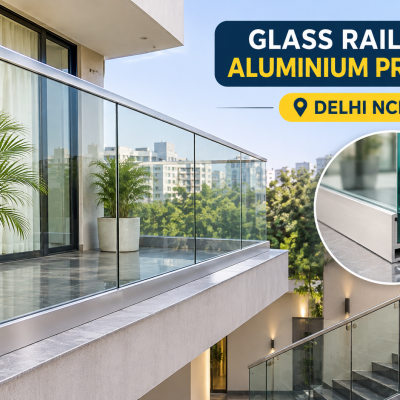
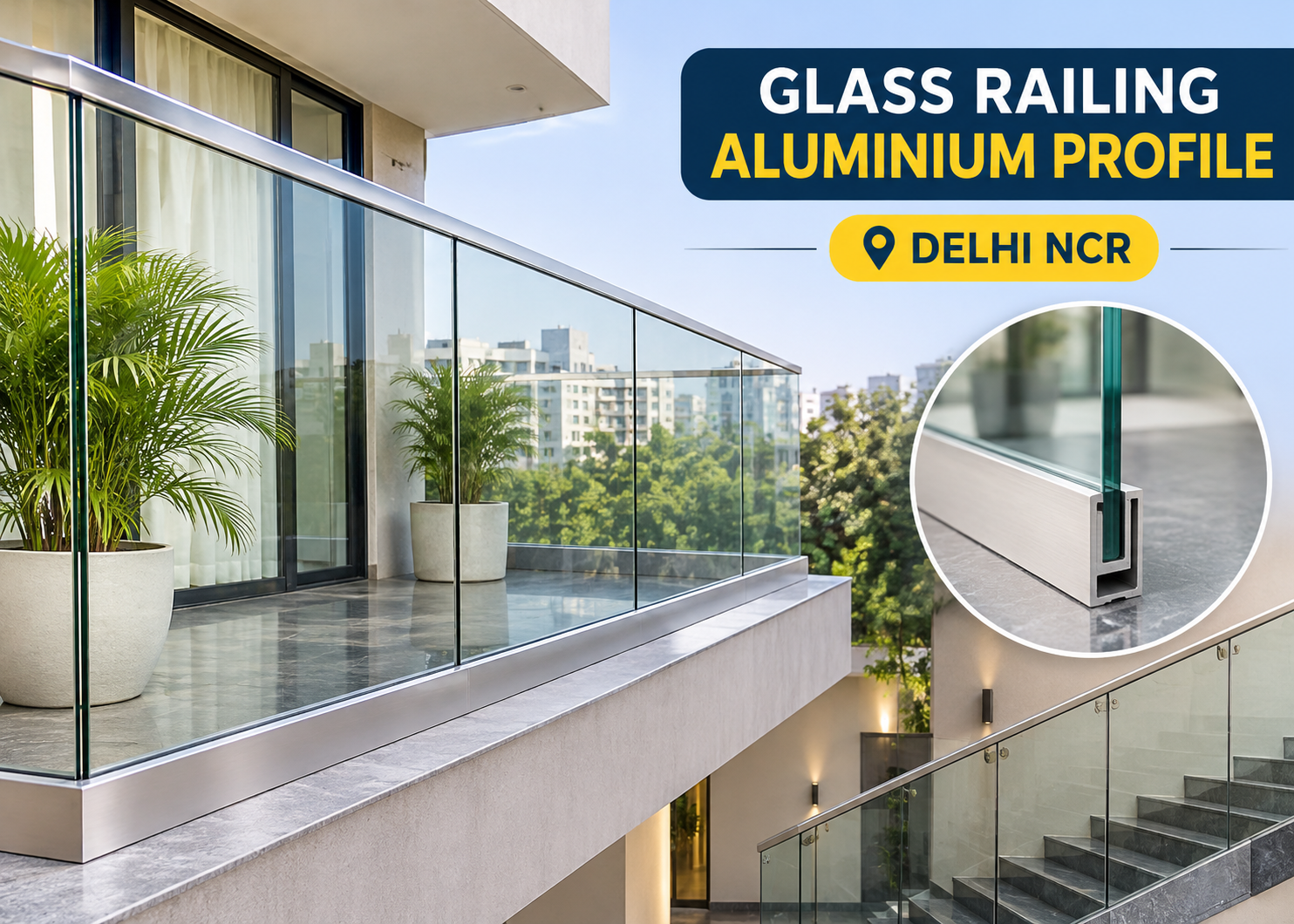
A glass railing aluminium profile is an extruded aluminium section that holds, supports or frames a glass panel in a balcony, terrace, staircase or mezzanine railing. Depending on the design, it may be a base channel the glass sits in, a post that carries the load, or a handrail that sits on top.
You’ll also hear it called an aluminium glass railing profile or glass railing channel. These all mean the same family of products. The difference between a good one and a bad one is small on paper: wall thickness, alloy, straightness and finish. On site, those small things decide whether the railing lasts or fails.
The Three Common Glass Railing Systems
Before choosing a profile, you need to know which system you’re building.
1. Frameless glass railing with a base channel
This is the most requested design in Delhi NCR right now. The glass sits in a long aluminium U-channel fixed to the floor or slab edge, with no posts in between. It gives the cleanest view. The channel has to be rigid, because it carries the full load of the glass and anyone leaning on it.
2. Semi-frameless glass railing with posts
Vertical aluminium posts at set intervals hold glass panels between them. It uses less glass and gives you better control over spacing, which suits long terraces and staircases.
3. Side-mounted (fascia) glass railing
The profile is fixed to the side of the slab or staircase edge instead of the top. This keeps the floor area clear, which is handy on narrow balconies. The fixing needs more care because the load acts sideways on the anchors.
If you’re still working out which one fits, tell us the location and span. It’s usually the first question we ask.
Matching the Profile to the Glass
This is where most mistakes happen.
Glass thickness and channel width must agree. Toughened glass for railings is commonly 10 mm to 12 mm, and laminated glass is often thicker. The channel’s internal width has to allow for the glass plus the packing or gasket. Too tight, and you risk chipped edges while fitting. Too loose, and the panel rattles. Always measure the actual glass delivered, not the thickness on the drawing.
Toughened vs laminated. For upper floors and any spot where a fall is a real risk, many architects prefer laminated toughened glass because the panel holds together if it breaks. Your architect or glass supplier should confirm which suits your project and local requirements.
Wall thickness matters more than it looks. Two sections can look identical in a photo, but one can be noticeably thinner. Under load, the thin one flexes. For a frameless glass railing aluminium profile, ask for the actual wall thickness in writing instead of “heavy duty”.
What to Check in the Aluminium Itself
When a fabricator picks up a section at our counter, this is what we suggest they look at.
- Alloy and temper. Most architectural sections are made from 6063 alloy, commonly in T5 or T6 temper. It extrudes cleanly, takes finishes well and is easy to cut and drill.
- Straightness. Sight down the length of the section. A bowed or twisted profile leaves gaps that no sealant can hide.
- Surface quality. There should be no dents, die lines or rough patches, especially on the visible faces.
- Consistent dimensions. Sections from different batches can vary slightly. For a long railing, try to order everything together.
Powder Coating or Anodising for Delhi Weather?
Delhi is tough on metal. Summers go past 40°C, dust gets into every joint, and monsoon humidity does the rest.
- Powder coated aluminium offers a wide choice of colours (matte black, grey, bronze, wood tones) and a thicker protective film. For exposed balconies and terraces, it’s usually the more forgiving choice.
- Anodising builds a hard oxide layer into the surface and suits a natural metallic look, particularly indoors or in sheltered spots.
One practical tip: do all cutting and drilling before the finish is applied. A cut on a finished section exposes bare metal, and that’s where problems usually begin. Our guide to powder coated aluminium profiles goes deeper into this.
Quick Reference: Which Profile for Which Job
| Location | What matters most | Suggested approach |
|---|---|---|
| Residential balcony | Clean look, firm base | Frameless base channel, powder coated |
| Staircase | Rigid handrail, safe edges | Semi-frameless posts with a cap rail |
| High-rise terrace | Wind load, anchor strength | Thicker section, laminated glass |
| Commercial staircase | Heavy daily use, code compliance | Heavier section, tougher finish |
| Indoor mezzanine | Appearance, slim sightline | Slim profile, anodised or fine powder coat |
Handrail Height and Safety: Don’t Guess
Minimum railing heights are set by building codes and can differ between residential, commercial and public buildings. Many residential balcony railings are built at around 1000 to 1100 mm, but please confirm the requirement for your project with your architect or the relevant authority. A profile can only be chosen properly once those basics are fixed.
Mistakes We See Again and Again
- Choosing a glass railing aluminium profile on price per kilo without asking about wall thickness
- Ordering the channel before the glass is finalised, then finding the sizes don’t match
- Using an indoor finish on an open balcony
- Fixing a heavy base channel with weak or poorly spaced anchors
- Skipping drainage in the channel on open terraces, so water sits at the base of the glass
- Mixing sections from different batches and ending up with slightly different shades
None of these are hard to avoid. They just need a few minutes of attention before the order goes out.
Where Domal and Imported Profiles Fit In
For premium homes and architect-led projects, a slimmer sightline and a finer finish can make a real difference, especially on a feature staircase or a glass-fronted balcony. That’s where a Domal series profile or an imported glass profile is worth a look. For most standard residential and commercial jobs, a good-quality regular section is perfectly adequate.
Final Thoughts
You’ll rarely hear anyone praise the channel under a glass railing. They’ll just enjoy the view. But if the profile is wrong, everyone notices sooner or later.
At Bahubali Aluminium Co., we’ve been supplying aluminium sections from our Paharganj base to fabricators, architects and builders across Delhi, Gurugram, Noida, Faridabad and Ghaziabad. If you send us your glass thickness, span and location, we’ll help you match the right section the first time. If you’re also comparing sources, our post on choosing an aluminium railing profile supplier in Delhi covers what to look for. You can browse our Railing Profiles, check the catalogue, or contact us.
Visit: Bahubali Aluminium Co., G-12 Pushpa Complex, D.B. Gupta Road, Paharganj, New Delhi 110055
Call: Sanjay Jain +91 9811073759 | Samyak Jain +91 9310488239
Frequently Asked Questions
1. What size aluminium channel do I need for 12 mm glass?
The internal width must fit the glass plus the packing or gasket, so it’s slightly wider than 12 mm. The exact size depends on the channel design, so confirm it against your actual glass before ordering.
2. Is a frameless glass railing safe on a high-rise balcony?
It can be, when the glass, the aluminium glass railing profile and the anchors are all designed for the load and wind exposure. Laminated glass and a thicker base section are commonly preferred on upper floors. Ask your architect to confirm.
3. Which finish is better for a glass railing in Delhi?
For open balconies and terraces, powder coating is generally the safer choice. Anodising works well indoors and in covered areas.
4. Can I use the same profile for both balcony and staircase railings?
Sometimes, but staircases usually need a stiffer handrail and attention to the stepped base. It’s best to check the profile for each location.
5. Do you supply outside Delhi?
Yes. We regularly dispatch to fabricators and contractors in Gurugram, Noida, Faridabad and Ghaziabad, along with walk-in supply from Paharganj.