
A solar panel is expected to work for 25 years. The structure underneath it? Many people choose it in five minutes, usually on price alone.
That is where trouble starts. Not in year one, but around year four or five, when a rail has started to sag, a bolt has gone white with corrosion, or a gust during pre-monsoon storms has shifted a row of panels. By then the panels are fine. The structure isn’t.
At Bahubali Aluminium Co. we have been working with aluminium for over 25 years from our shop in Paharganj, and we regularly talk to installers, fabricators and builders about exactly this. So here is a plain-language guide to aluminium solar profiles: what they are, what to look at, and where people usually go wrong.
What Are Aluminium Solar Profiles, Really?
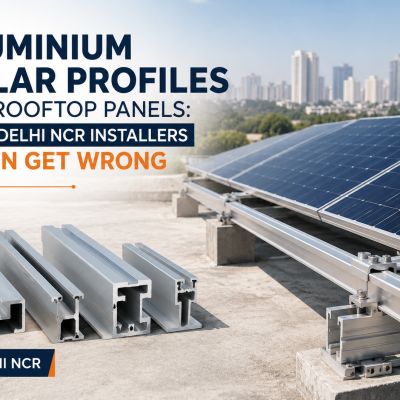
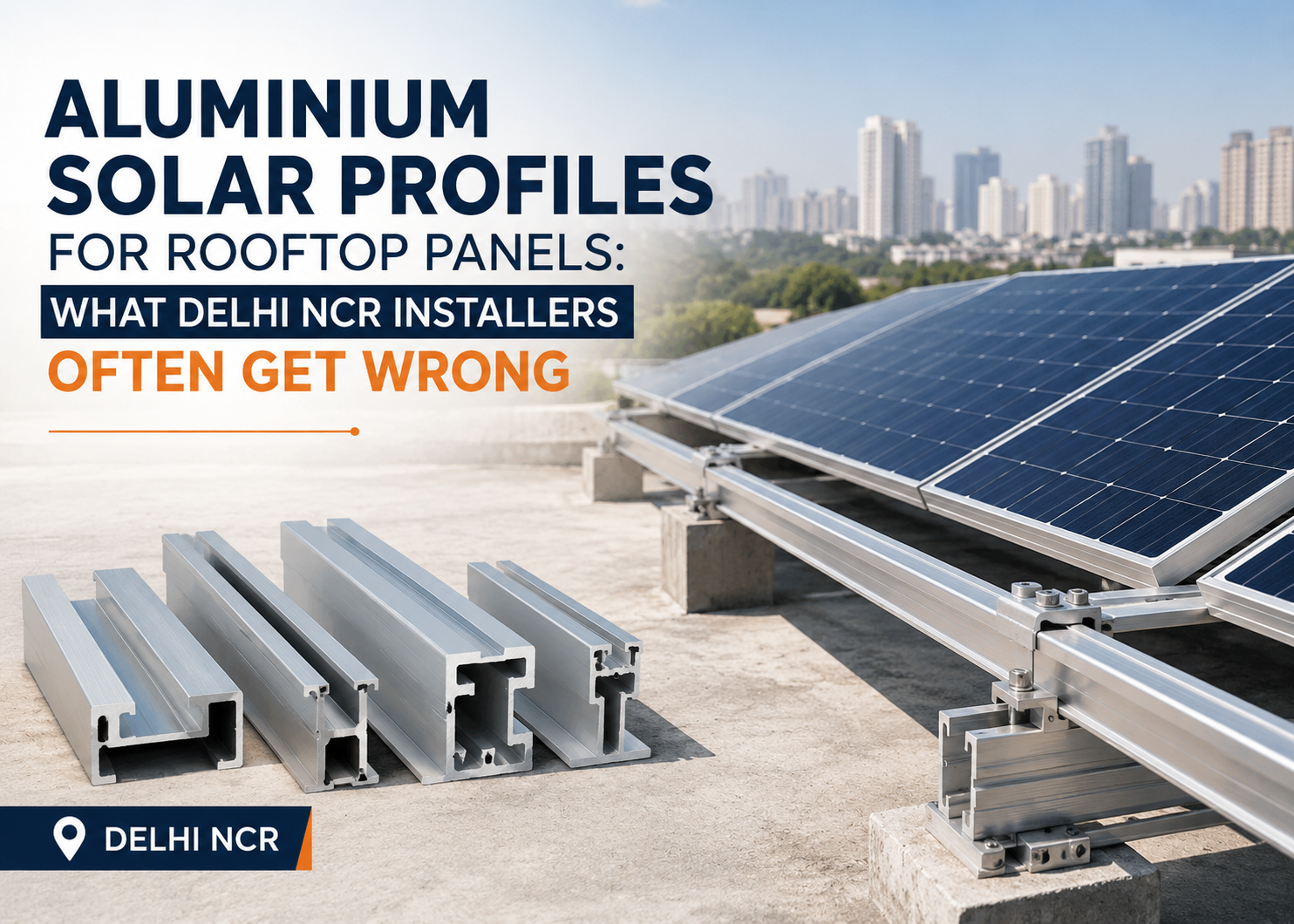
Aluminium solar profiles are extruded aluminium sections used to build the solar panel mounting structure. That includes the rails the panels sit on, the channels and brackets that connect those rails to the roof or ground frame, and the sections that hold panels in place.
Think of them as the skeleton. The panel gets all the attention, but the skeleton decides whether it stays flat, stays aligned and stays put.
Why aluminium and not steel? Three reasons come up again and again:
- It doesn’t rust. Aluminium forms a thin natural oxide layer, so it handles Delhi’s monsoon far better than uncoated steel.
- It is light. Rooftop jobs in Delhi NCR often mean carrying material up narrow stairs. Lighter sections mean faster, safer installation.
- It can be extruded into any shape. The section can be designed around the job instead of forcing the job around a standard angle iron.
If you want to see what we offer in this category, our Aluminium Solar Profiles page lists the specifications and finishes.
1. Check the Alloy, Not Just the Shape
Two rails can look identical and behave very differently. Most aluminium solar mounting rails are made from 6063-T6 or a similar structural alloy. The “T6” part refers to the heat treatment, and it matters. A softer temper bends under load and doesn’t spring back.
Ask whoever is quoting you which alloy and temper the section is made from. If they can’t answer, or the answer changes between phone calls, treat that as information.
Also look at wall thickness. Thin walls are the easiest place to save cost and the easiest place for a section to fail. Hold two sections side by side and the difference is usually obvious.
2. Anodised or Powder Coated? It Depends on the Site
Both finishes protect the metal. They suit different situations.
Anodised finish is part of the aluminium surface itself, so it won’t peel or flake. It works very well for rails that stay in plain view and see heavy sun.
Powder coating gives you colour options and a thicker protective layer, which helps near coastal-style humidity or when the structure needs to match a building. If you are weighing finishes for Delhi’s heat and dust, we wrote about it in detail in our guide to powder coated aluminium profiles.
For most rooftop jobs in Delhi NCR, either works well when done properly. What doesn’t work is a coating that is too thin or applied over poorly cleaned metal. Ask how the finish is applied, not only what it is called.
3. Wind Load Is Not a Technicality
Delhi sits in a high basic wind speed zone as per IS 875 (Part 3), and rooftop panels act like sails. A tilted array on an open terrace in Dwarka or Gurugram takes real force during storms.
This is where the solar structure profiles you choose earn their keep. A section that looks fine on a table can twist under uplift if the cross-section isn’t deep enough or the span between supports is too long.
Don’t guess here. Get the span, tilt and section depth checked against the load. If your project is large or on a tall building, involve a structural engineer. A good supplier will help you with section choices, but the final load calculation belongs with a qualified engineer.
4. Fasteners and Galvanic Corrosion
This is the one that surprises people. Aluminium itself is fine in the weather. The trouble starts when it touches the wrong metal.
When aluminium sits against plain carbon steel or copper in a damp environment, it can corrode faster than it would alone. In practice, this is why you see white powdery patches around bolts on old installations.
The fix is straightforward:
- Use stainless steel (A2/304 or better) fasteners with aluminium sections.
- Use washers or isolating pads where different metals meet.
- Avoid mixing random hardware picked up on the day of installation.
It costs very little at the start and saves a lot later.
5. Plan for Expansion
Aluminium expands with heat more than steel does. A 6-metre rail can change length by roughly 7 mm between a cold January morning and a 50°C summer roof. That sounds small, but if every bolt is tightened with no allowance, the stress has to go somewhere.
Leave slotted holes or small gaps in long runs, and don’t tighten everything rigidly. It’s a small detail, and it separates a neat installation from one that creaks and warps.
6. Match the Profile to the Panel
Panels differ. Frame thickness, size and weight vary between manufacturers, and aluminium solar profiles need to work with both framed and frameless modules. Before ordering, confirm:
- Panel dimensions and frame thickness
- Clamp type (end and mid clamps)
- Rooftop type: RCC slab, metal sheet or ground mount
- Tilt angle and row spacing
Getting these wrong means cutting, drilling and improvising on site, which is how installations lose both neatness and strength.
Rooftop Solar Is Growing in Delhi NCR, and Structure Quality Matters More Now
More homes and small businesses are going solar, helped by schemes like PM Surya Ghar. That is good news. But a larger number of installations also means more shortcuts from people trying to compete on the lowest quote.
Whether you are an installer, a contractor or a building owner, the sensible approach is the same. Ask what the structure is made of, how it is finished, and how it was designed for wind. Then compare quotes on that basis, not just on the rupee figure.
Working With a Local Aluminium Profile Manufacturer
There is a practical advantage to buying from a aluminium profile manufacturer in Delhi rather than a distant trader. You can walk in, see the section, hold it, check the thickness and talk to someone who has handled the job before. If you need a custom length or a slightly different section, the conversation happens in a day, not three weeks.
At Bahubali Aluminium Co., we supply sections for residential, commercial and industrial solar projects, in natural anodised or powder-coated finishes, and can help you pick what suits your site. You are welcome to visit us at G-12 Pushpa Complex, D.B. Gupta Road, Paharganj, New Delhi, or look through our catalogue first.
Quick Checklist Before You Order
- Alloy and temper confirmed (not just “aluminium”)
- Wall thickness suits the span
- Finish type and thickness explained
- Stainless fasteners and isolation planned
- Expansion allowance in long rails
- Wind load checked for your location
- Compatibility with your exact panel model
Frequently Asked Questions
Which aluminium is best for solar mounting?
Structural alloys like 6063-T6 are widely used because they balance strength, corrosion resistance and easy extrusion. Always confirm the exact alloy with your supplier.
Is anodised or powder coated better for solar rails?
Both perform well outdoors. Anodised suits exposed, sun-heavy rails; powder coating adds colour options and a thicker barrier. The quality of the process matters more than the label.
Can aluminium profiles be customised for a solar project?
Yes. Lengths, cuts and finishes can usually be tailored to your panel size and roof layout. Share the layout early so the profile can be planned properly.
Do aluminium solar structures need maintenance?
Very little. Check fasteners and look for loose clamps once a year, especially after the monsoon.
Final Thought
Panels get the headlines, but the structure carries the responsibility. Spending a little more care on alloy, finish, fasteners and wind load now is the difference between a system that quietly performs for decades and one that needs repairs before its first warranty review.