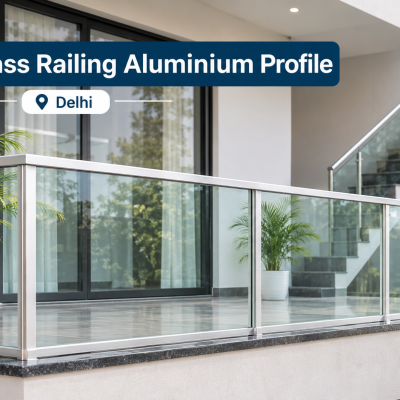

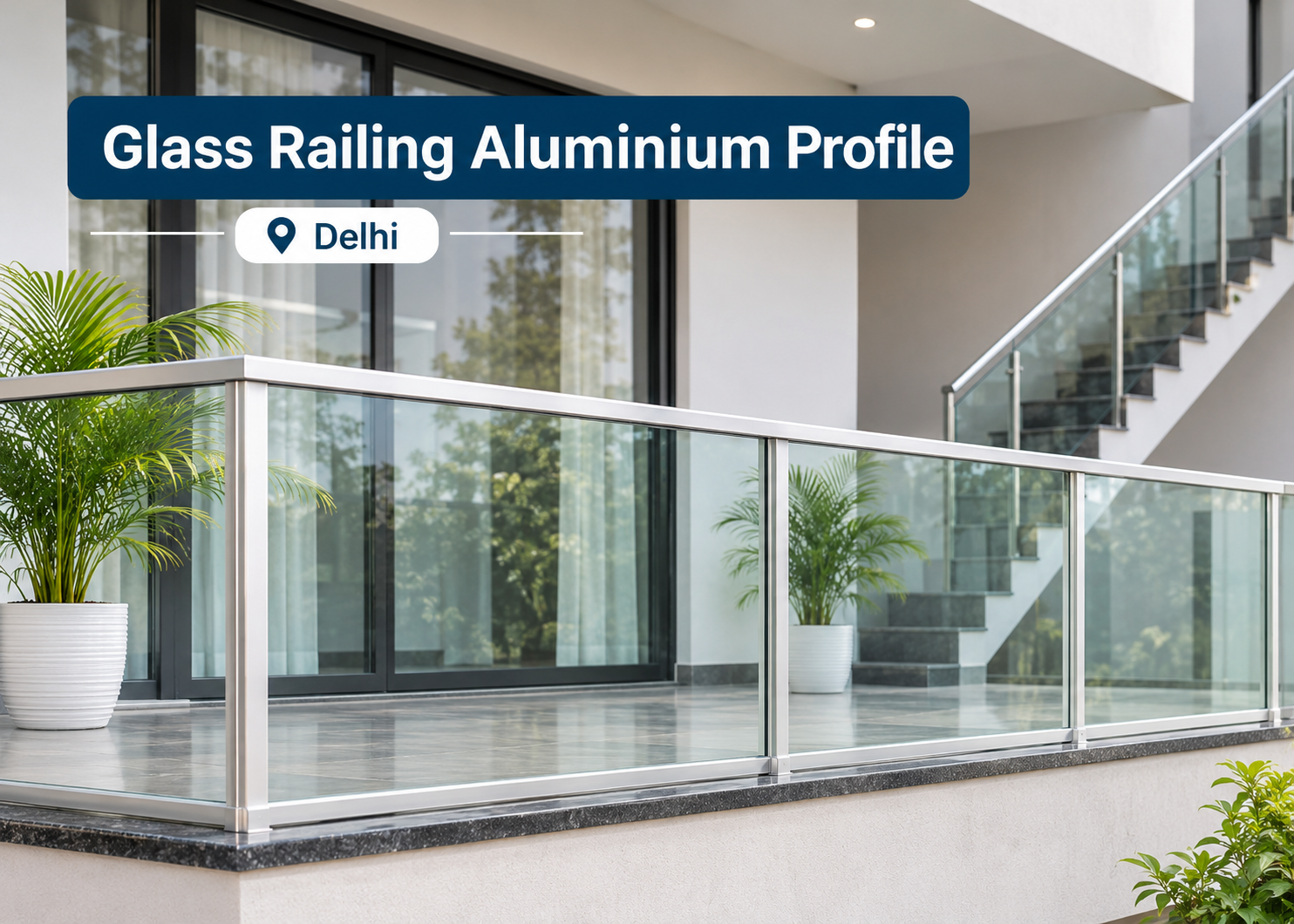
Most people choose the glass first. They scroll through photos of clean, clear balconies, settle on a thickness, maybe a slight tint, and only then wonder what’s going to hold it all up. It’s the wrong way round. Glass is the part everyone notices, but the glass railing aluminium profile underneath decides whether that railing still looks straight in year five.
At Bahubali Aluminium Co., we’ve been supplying and advising on aluminium sections from our Paharganj shop for over 25 years. In that time, glass railings have gone from a rare, expensive extra to something we’re asked about every week. This guide covers what we’d tell any homeowner, architect or fabricator in Delhi NCR before they place an order.
What a Glass Railing Aluminium Profile Actually Does
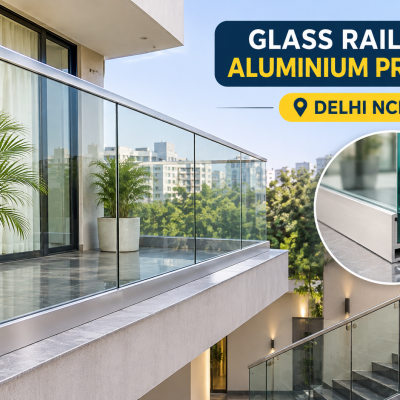
It’s more than a frame. An aluminium glass railing profile grips the glass, passes the load down into the slab, keeps water and dust out of the joint, and gives the whole thing a finished edge. Most systems use a mix of three parts:
- A base shoe (or base channel) that holds the bottom edge of the glass
- Posts or clamps, if the design isn’t fully frameless
- A top cap or handrail section for the part people touch
Nearly all of these are extruded from 6063-grade aluminium, which is the standard alloy for architectural sections. It’s strong enough for the job, takes powder coating well, and doesn’t rust.
Frameless or Framed: Which System Suits Your Space?
This is the first real decision, and it shapes everything after it.
| System | Best for | Watch out for |
|---|---|---|
| Frameless glass railing (U-channel base) | Modern apartments, villas, feature balconies | Needs a heavier channel and a solid, level slab edge |
| Post and glass | Uneven slabs, longer spans, budget-conscious jobs | More visible hardware, more joints to clean |
| Glass with a top handrail | Staircases, terraces, homes with children or elderly family | Slightly heavier look |
A frameless glass railing is the one that photographs beautifully, and we get why people want it. But it only works if the base is dead level and the channel is properly anchored. On an older Delhi building with a slightly crumbly slab edge, a post-and-glass system is often the saner choice, and we’ll say so.
Matching the U Channel to Your Glass Thickness
This is where most problems start. A U channel for glass has to leave a small, planned gap on both sides of the panel, because the glass is held by rubber wedges or gaskets, not squeezed directly against the metal. Too tight, and you risk chipped edges during fitting. Too loose, and the panel can shift or rattle once the wind picks up.
Some numbers help here. Toughened glass at 12 mm weighs roughly 30 kg per square metre, so a panel a metre wide and a metre tall is already around 30 kg sitting in that channel. For terraces on higher floors or any public-facing space, many designers go for laminated glass instead, because it holds together if it ever breaks.
The exact channel dimensions vary from one system to another, so don’t guess from a photo. Take a sample of your actual glass, or at least its exact thickness, and check it against the channel’s inner width before you order. Glass thickness has tolerances too, and that small difference matters more than people think.
Delhi’s Weather Is Hard on Railings
A railing in Delhi doesn’t live an easy life. It sits through 45°C afternoons, dust storms, and a monsoon that can leave water standing in places you didn’t expect. A few things follow from that.
Heat and expansion. Aluminium moves with temperature. On long runs, a continuous profile with no allowance for expansion can buckle slightly or stress its joints. Break long lengths into sensible sections and leave small gaps where the design allows.
Drainage. Outdoor base channels collect rainwater. If there are no weep holes, that water sits against the glass edge and the fixings. It’s a small detail that gets skipped surprisingly often.
Finish. A good powder coated aluminium profile handles our dust and monsoon cycle far better than a bare or thinly coated section. We wrote a separate piece on choosing a powder coated finish for Delhi’s heat, dust and monsoon if you want the detail.
Fasteners. Use stainless steel fixings, and keep them isolated from the aluminium where you can. Mixing the wrong metals in a wet environment invites corrosion at exactly the point you can’t easily see.
Five Mistakes We See Again and Again
- Buying glass before choosing the profile. If the glass is already cut to size, you’re now forced to find a channel that fits it, instead of the other way round.
- Ignoring the slab edge. A cracked or uneven edge will undermine even a good profile. Fix the base first.
- Going for the thinnest, cheapest section. A glass railing carries real load, so the wall thickness of the base channel isn’t the place to save money.
- Forgetting the top rail on terraces. A frameless look is lovely, but on an exposed terrace a handrail adds comfort, rigidity and peace of mind.
- Skipping drainage detail. Water trapped in a channel quietly does damage for years before anyone notices.
Balcony, Terrace or Staircase: Small Differences That Matter
A balcony glass railing is usually the simplest. Height is the main thing to get right, and for residential balconies it’s typically around a metre. Confirm the exact figure against the National Building Code and your architect’s drawings, since requirements can vary by building type and floor.
Terraces, especially on upper floors in Gurugram or Noida, face stronger wind. That means thicker glass, a sturdier channel and firmer anchoring.
A staircase glass railing is the trickiest. The glass follows the angle of the stairs, so the base channel has to be cut or fixed to suit that slope. This is where off-the-shelf thinking fails, and where a short conversation with your fabricator before ordering saves a lot of rework.
A Quick Bench Check Before You Buy
You don’t need lab equipment to judge a profile. Four simple checks will tell you a lot:
- Measure the wall thickness with a caliper, and compare it across a few pieces from the same batch.
- Hold a length up and sight along it. It should be straight, without a visible twist.
- Look at the coating on a cut edge. It shouldn’t flake or chip when you scratch it lightly.
- Slide a piece of the actual glass into the channel and see how it sits.
Doing this at our shop takes about ten minutes, and we’d rather you did it than discovered a problem on site.
Frequently Asked Questions
What thickness of glass is normally used with a glass railing aluminium profile?
or residential balconies and staircases, 10 mm to 12 mm toughened glass is common. Taller, more exposed or public installations often use thicker laminated glass. The channel must be chosen to match.
Is a frameless glass railing safe?
Yes, when the profile, glass and anchoring are all specified correctly and installed on a sound base. Safety comes from the whole system, not from any single part.
How do I maintain an aluminium glass railing profile?
Wipe it with mild soapy water and a soft cloth, and avoid harsh acid-based cleaners that can damage the coating. Clear dust and debris from the channel before the monsoon, and check the rubber wedges once a year.
Can I fit a glass railing on an existing balcony?
Often, yes, but the slab edge needs to be sound and level. A site check first is wise, particularly in older buildings.
Does the profile affect the final cost of a glass railing?
It does. Wall thickness, finish quality and the system type all influence cost. A well-chosen profile usually costs less over time than one that needs replacing or re-fixing.
Get the Channel Right the First Time
A glass railing is one of those features you only really notice when something’s wrong with it. Choosing the profile with the same care you gave the glass is the simplest way to avoid that.
You can browse our railing profiles range, read our guide to the aluminium U profile and where it’s used, or look through the full catalogue. If you’d rather talk it through, send us your glass thickness and site details through the contact page, or call Sanjay Jain on +91 9811073759 or Samyak Jain on +91 9310488239. We’re at G-12 Pushpa Complex, D.B. Gupta Road, Paharganj, New Delhi, and we regularly supply fabricators and builders across Delhi, Gurugram, Noida, Faridabad and Ghaziabad. Bring a sample of your glass, and we’ll check the fit with you.